Project Vani Capstone Documentation
Complete Credits to Acquired Assets & References:
https://docs.google.com/document/d/1uT6bBfMlGx0FeE8Q9oS9-Q_HSxyFuHnSvPb_Kk34_9E/edit?usp=sharing
My semester capstone project at the University of Michigan, delving into solo-game development and design.
When embarking on Project Vani, I explored the collage-like nature of video game design for they are as much curation as creation. Materials and myth are modeled, constructed, sewn, repurposed, appropriated, edited, and composed in order to create a holistic experience. In particular, this experience deconstructs the action adventure genre by subverting audience expectations of a hero versus beast adventure. Rather than move to slay a monster, Project Vani engages the player to build empathy with the creature in a symbiotic relationship. They put themself in danger to clean and care for the Karkadan, a Persian mythological creature, while harvesting alchemical materials for their townsfolk.
Special thanks to Arts at Michigan @ Umich.
“You are Vanihita, the recently trained Alchaemist now in charge of caring for ancient guardians of immense magical power. In tending to these creatures, you gather components to help your fellow townspeople, The Sima, a group blessed by the Simurgh"

Project Vani is level and game design exercise creating a proof-of-concept experience of a deconstructed action-adventure game. Key gameplay features a climbing system package developed by Dias Games.

Isometric top down view of level in Unity. The area is composed of a Unity terrain object decorated with various trees (Landen Lloyd) and grass (Brackeys) and Unity 3D Game Kit rocks. These items were colored with a triplanar shader.

A view of the world in the Unity Editor. Project Vani evolved into a collage level and game design exercise as I explored the assembly, appropriation, and acquisition of assets in a short-term solo development project.
Mockup of Karkadan creature created in Maya. Upon working through the rig and animations, I decided to only use this model as a reference when constructing the karkadan with other sourced assets

Initial sketch used as reference when modeling Karkadan.
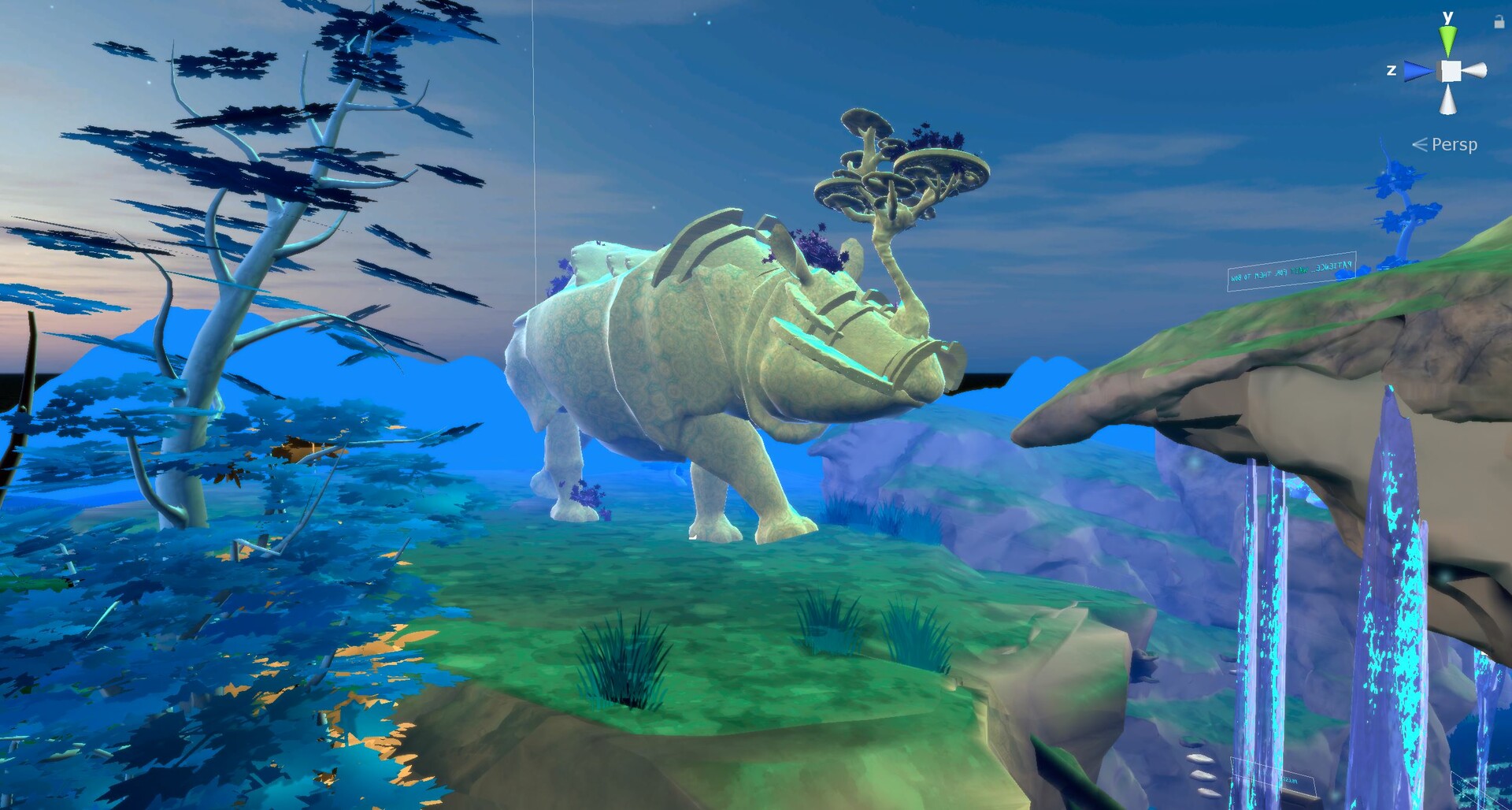
Final Karkadan in Unity: created with WDALLGRAPHICS's rhinoceros model, environment items from Unity 3D Game Kit, and iridescent shader referenced from JoyceMinionsArt. My greatest challenge was creating a cohesive, climbable beast with reliable colliders

Turnaround for a character that did not make it into the prototype: Vanihita's mentor, Vauban.

Concept sketches for a helpful forest guardian, Nashandra, who was initially to manage a pseudo-death mechanic where she would save you via teleportation only if you abided by the nonviolent ways of the Sima.

One major challenge I had was adjusting this project to suit a gallery exhibition space, rather than a gaming audience. This fueled a shorter, timed game loop with integrated tutorial.

Funded by Arts at Michigan Student Mini-Grant at the University of Michigan. More Information at http://artsatmichigan.umich.edu/funding/smg/